



 HOMEPAGE
Latest News.


The Alliance sometimes
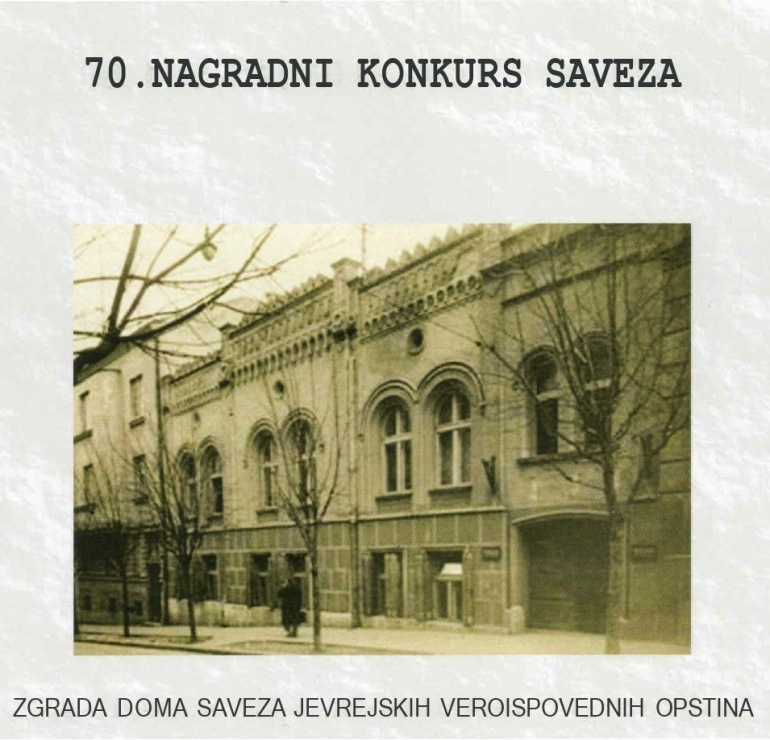
The Federation of Jewish Communities has existed for 89 years under various names. However, two decades had to pass from the inception of the idea of the need to establish a strong body capable of representing the interests of the entire Jewish community in this region, until its implementation. Finally, in July 1919, in Osijek, the Union of Jewish Religious Communities of the Kingdom of Serbs, Croats and Slovenes was established. The organization under thatby name, was the predecessor of the former Union of Jewish Communities of Yugoslavia and the current Union of Jewish Communities of Serbia, and it was the first institutionalized form of association of Jewish communities in the South Slavic countries.
The events of 1919 clearly demonstrated the necessity of establishing a unified Jewish organization that would advocate for and protect the interests of Jews dispersed in small communities, who were insufficiently equipped to fight for their rights. In the territory of the Kingdom of Serbs, Croats and Slovenes, approximately 80,000 to 100,000 Jews lived in small Jewish communities. They were divided, in a weak position, without an authoritative commonan organization that would unite, represent, and advocate for their interests.
The establishment of the Union of Jewish Religious Communities of the Kingdom of Serbs, Croats, and Slovenes significantly altered the existing state of affairs in the turbulent Balkan region. Between the two World Wars, from 1919 to 1941, the Union primarily engaged in cultural, educational, and religious activities. However, it also had to enter the political arena, as it was necessary to oppose measures that adversely affected Jews (e.g., the Decree on the Expulsionforeigners in 1919), manifestations of anti-Semitism, occasional anti-Jewish campaigns, up to the introduction of the numerus clausus in 1940, for the enrollment of Jews in secondary schools and universities, and the prohibition of engaging in certain professions, such as the food trade.
After Hitler came to power in Germany in 1933, the Alliance paid special attention to helping Jews who were leaving that country, and later Austria, Czechoslovakia, and Poland, and who were traveling through Yugoslavia to countries that provided them with refuge.
After the collapse of the Kingdom of Yugoslavia, the most difficult period in the life of our Jewish community began. Approximately 86 percent of Jews from the territory of present-day Serbia perished in the Holocaust, and out of 55 municipalities (including nine Orthodox ones that had their own separate organization), the number has now dwindled to ten.Jewish property was looted, synagogues were demolished, and a large part of the cemeteries was left neglected or completely destroyed.
The work of the Union was interrupted for almost four years until the liberation of the country. After World War II, the surviving Jews, with the volunteer work of individuals and the assistance of Jewish organizations, rebuilt and resumed the activities of their communities.
Between 1948 and 1952, significant activities of the Alliance were focused on the emigration of Jews to the State of Israel. In several waves of emigration during that period, about 4,500 Jews left. Despite the fact that just over 3,000 Jews remained in the country, mostly elderly, Jewish life did not cease, thanks, among other things, to the assistance provided by Jewish organizations around the world, primarily JOINT.
The Jewish Historical Museum was established, the publishing activities of the Alliance were resumed, and a large number of titles were published. Jewish cultural, educational, and religious life continued.
The Federation of Jewish Communities of Yugoslavia existed until the dissolution of that state. With the creation of new states from its former republics, unions of Jewish communities were established, bearing various names: Coordination of Jewish Communities of Croatia, Jewish Community of Bosnia and Herzegovina, Jewish Community of Macedonia, Jewish Community of Slovenia, etc.).
The breakup of Yugoslavia, armed conflicts, and sanctions imposed new tasks on the Federation of Jewish Communities of Yugoslavia: providing assistance in the form of food, clothing, and medicine, organizing accommodation for fellow refugees from Bosnia and Herzegovina, and later facilitating their evacuation to Israel and other countries.
During the 77-day NATO bombing campaign, the Alliance evacuated approximately 600 of its members from the bombed cities to Hungary, and from there to Israel and some other countries. In those difficult days, Jewish organizations around the world, primarily JOINT, provided and demonstrated great assistance and solidarity. We owe special gratitude for the selfless fraternal assistance provided by the Alliance of Hungarian Jews.
Following the separation of Serbia and Montenegro, in June 2006, The Federation of Jewish Communities of Yugoslavia changed its name to the Federation of Jewish Communities of Serbia.
The founders of the Federation of Jewish Communities of Serbia are the Jewish communities of Belgrade, Novi Sad, Subotica, Zrenjanin, Zemun, Pančevo, Sombor, Kikinda, Niš and Priština (based in Belgrade), which are the successors of the legal personality of the Jewish religious community acquired on the basis ofLaw on the Religious Community of Jews in the Kingdom of Yugoslavia
(Official Gazette of the Kingdom of Yugoslavia No. 301/1929)