


 HOME
Latest News.


History of the SJOS Award Competition
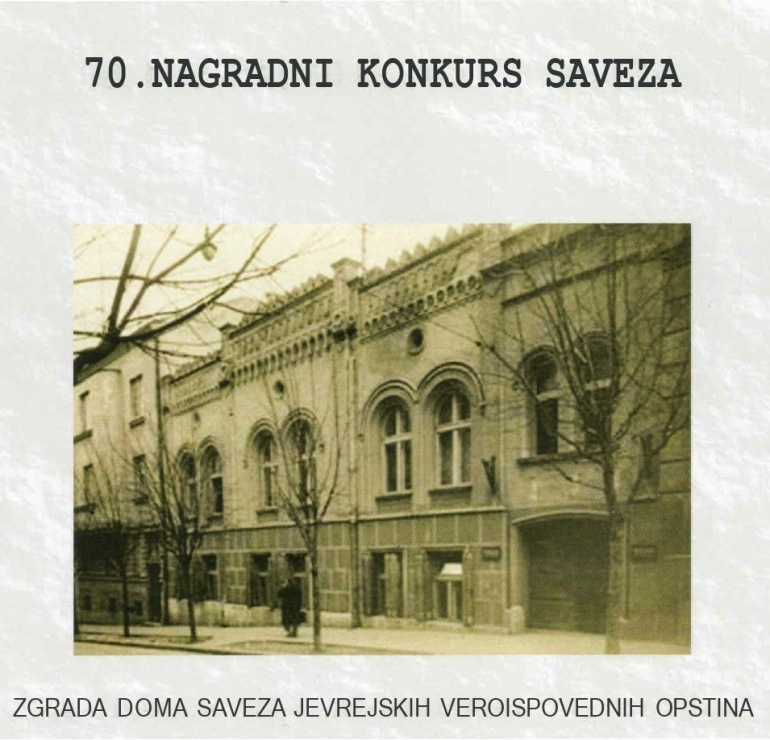
The competition was established in 1954 on the initiative of the president of the then Association of Jewish Communities of Yugoslavia, Dr. Albert Weiss, and the first awards were presented in 1955. It was only not announced twice, in 1992 and 1994, during the civil war in the territory of the former Yugoslavia. The competition covers works with Jewish themes in the fields of science, history, literature, art, memoirs, and the Holocaust.Only in the first year was it announced for both fine arts and music. Over time, the competition for works with Jewish themes has become a traditional cultural event with a reputation extending beyond the Jewish community, and it is participated in by both Jewish and non-Jewish artists. To date, several hundred authors have participated, submitting over 1,800 works, and the award winners include authors of works from Australia, Austria,England, Israel, Canada, the USA, Croatia, Bosnia and Herzegovina, and Montenegro. Authors who later became established writers or academics also participated in the competition and were awarded prizes, such as: Danilo Kiš, David Albahari, Filip David, Gordana Kuić, Zvonimir Palanski, Ljubica Arsić, Vojislav Maksimović, Krinka Vidaković (later Ambassador of Serbia and Montenegro to Israel), Radivoje Davidović, HansBramer, Dragoljub Čolić, Miroslava Despot, Zora Dirnbach, Dimitrije Mašanović, Avram Pinto, Vidosava Nedomački, Ljubivoje Ršumović, László Székely, Mirjana Belić-Koročkin-Davidović, and others.
The recipient of the highest number of awards to date is Ženi Lebl, the author of 24 award-winning works dedicated to the study of the history of the Jews of Serbia, and beyond.
The members of the jury were, and still are, well-known names in Yugoslav and Serbian science and culture: Aron Alkalaj, Isak Amar, Andrija Gams, Zoran Gavrilović, Ivan Ivanji, Ljubiša Jocić, Simha Kabiljo-Šutić, Lavoslav Kadelburg, Jacques Konfino, Aleksandar Levi, Julija Najman, Academician Predrag Palavestra, Miodrag Pešić, Andreja Preger, Radovan Samardžić, Dušan Sindik, Ana Šomlo, Filip David, Milan Ristović, and others.
The prizes were monetary, and the system for awarding them varied. In some competitions, prizes were awarded, usually three, regardless of the fields from which the works originated, while it was more common to award prizes for works categorized by fields: scientific, literary, memoir… so two or three prizes were given for each field. In some prize competitions, in addition to the award winners,There were also works that were evaluated in the “purchased” category, and their creators received smaller monetary amounts.
All works, whether awarded or not, are kept in the archives of the Federation of Jewish Communities of Serbia.
Numerous award-winning and purchased works have been published, with the authors’ consent, either in full or in excerpts, in several publications of the Federation, notably in the Jewish Almanac (published from 1954 to 1970) and in the jubilee edition of the Jewish Almanac 1971–1996 (dedicated to the 80th anniversary of the Federation of Jewish Communities of Yugoslavia (1919–1999)), as well as in a new publication by the Federation – the COMPENDIUM of the Jewishof the Historical Museum, whose first issue was published in 1971.